Best Movies of the 1990s — Why You Need to Go Back to Netflix and Remember What Cinema Felt Like
Published on January 5, 2026
by Don Larson
691 views
The 1990s weren’t just another decade of movies. They were a creative convergence — a rare moment when artistic ambition, studio resources, global cinema access, and audience curiosity all aligned. It was the last era before algorithms, IP exhaustion, and franchise dependency fully reshaped Hollywood. The result was a decade where original ideas thrived, mid-budget adult dramas flourished, and filmmakers were trusted to take real risks.
If you feel like something is missing from modern movies, it’s probably because you’re subconsciously comparing them to the 1990s.
Why the 1990s Were the Best Decade for Movies
1. The Sweet Spot Between Old and New Hollywood
The ’90s existed in a perfect balance. Directors still came up through film schools and cinephile traditions, but they had access to modern technology, larger budgets, and global distribution. You could make something bold and get it into multiplexes.
This is the era where auteurs like Martin Scorsese, Steven Spielberg, Terrence Malick, Quentin Tarantino, Krzysztof Kieślowski, Wong Kar-wai, and the Coen Brothers were all operating at or near peak power — often simultaneously.
2. Studios Took Risks on Adult Audiences
Studios once believed adults wanted challenging stories. And they were right. Movies like Goodfellas, JFK, The Thin Red Line, Breaking the Waves, and Three Colours: Red were not niche art films — they were cultural events.
Today, these films would struggle to exist outside prestige streaming silos. In the ’90s, they played in theaters.
3. Independent Film Actually Mattered
The indie boom wasn’t branding — it was real. Miramax (before its collapse), New Line, and international distributors brought daring voices into the mainstream. Trainspotting, Chungking Express, Hoop Dreams, and The Puppetmaster expanded what “popular cinema” could mean.
4. World Cinema Was Discoverable
Before streaming fractured attention, curious viewers actively sought out foreign films. VHS, DVD, Criterion, and repertory theaters mattered. The ’90s normalized subtitles for serious movie lovers, making global cinema part of the conversation rather than a side note.
5. Movies Were Allowed to Be Ambiguous
Endings didn’t explain themselves. Characters didn’t always “win.” Studios trusted audiences to sit with discomfort, contradiction, and moral gray zones. Films like The Long Day Closes or And Life Goes On don’t spoon-feed meaning — they invite reflection.
Why You Should Go Back to Netflix (or Any Streaming Service) Right Now
Streaming has flattened time. The ’90s are no longer “old”; they’re simply available. These films now live side-by-side with new releases, waiting to be rediscovered without hype cycles or box-office pressure.
Rewatching ’90s cinema reminds you:
What dialogue sounded like before quips became mandatory
What pacing felt like before everything needed to hook you in 30 seconds
What emotional weight looks like when films trust silence
Most importantly, it reminds you that movies once aimed to linger, not just entertain.
About This List (and Its Biases)
This list draws from an obsessive, cinephile-driven approach:
Best Picture nominees and winners
Palme d’Or winners
Criterion Collection entries
Rolling Stone’s top-100 lists
Roger Ebert’s four-star reviews
Siskel & Ebert’s annual rankings
And the broader canon of popular and international cinema
Even then, no list is complete. This one is openly subjective, idiosyncratic, and tiered rather than rigidly ranked. The gaps — particularly in Indian and under-explored world cinema — are acknowledged. The goal isn’t authority; it’s conversation.
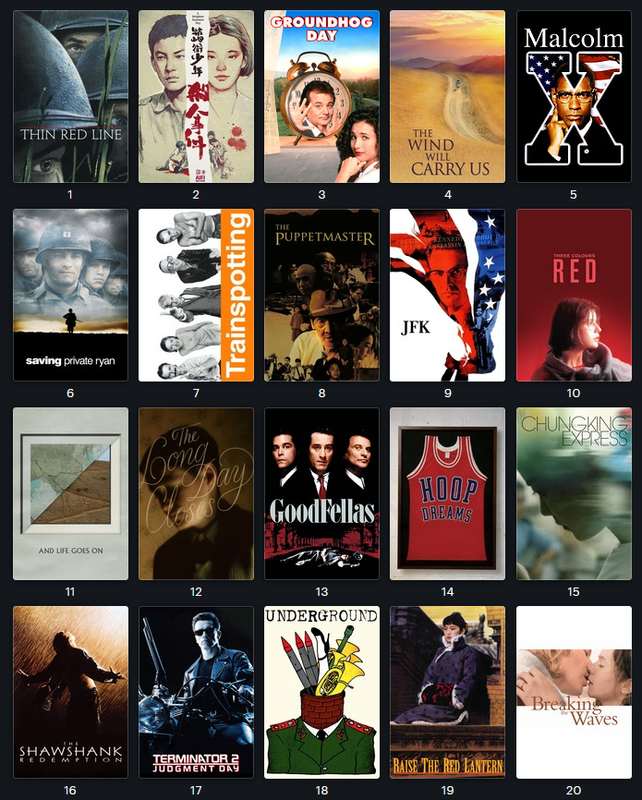
With that in mind, here’s a focused look at the top 20 films shown in the image, each representing a different facet of what made the 1990s extraordinary.
The Top 20 Films — Short Blurbs
1. The Thin Red Line (1998)
Terrence Malick turned a war film into a meditation on nature, mortality, and consciousness. It’s less about combat than humanity’s place in an indifferent universe.
2. Raise the Red Lantern (1991)
A masterpiece of visual control and emotional repression. Zhang Yimou uses color, architecture, and ritual to expose power structures and quiet cruelty.
3. Groundhog Day (1993)
A philosophical comedy disguised as a mainstream hit. Few films so elegantly explore time, self-improvement, and existential boredom.
4. The Wind Will Carry Us (1999)
Abbas Kiarostami’s gentle, profound reflection on waiting, death, and unseen lives. Cinema as observation rather than manipulation.
5. Malcolm X (1992)
Spike Lee’s epic is fearless, political, and operatic. Denzel Washington delivers one of the defining performances of the decade.
6. Saving Private Ryan (1998)
The opening battle redefined war realism. Beyond the spectacle, it’s a moral inquiry into sacrifice and collective responsibility.
7. Trainspotting (1996)
Danny Boyle captured youth, addiction, and rebellion with electric energy. Stylish, disturbing, and unforgettable.
8. The Puppetmaster (1993)
Hou Hsiao-hsien’s autobiographical epic merges history and memory with astonishing restraint. One of the quiet giants of world cinema.
9. JFK (1991)
Oliver Stone’s fever dream of paranoia and power. Less a history lesson than a portrait of American distrust.
10. Three Colours: Red (1994)
Kieślowski’s farewell film is deeply humane — a meditation on chance, connection, and moral responsibility.
11. And Life Goes On (1992)
A deceptively simple road movie about resilience after tragedy. One of the most life-affirming films ever made.
12. The Long Day Closes (1992)
Terence Davies transforms memory into poetry. Childhood, cinema, and longing melt into pure feeling.
13. Goodfellas (1990)
Scorsese at full throttle. A seduction and indictment of criminal glamour that still feels alive with danger.
14. Hoop Dreams (1994)
A documentary with the emotional depth of great fiction. Few films capture American hope and inequality so honestly.
15. Chungking Express (1994)
Wong Kar-wai’s love letter to urban loneliness. Fragmented, romantic, and endlessly influential.
16. The Shawshank Redemption (1994)
Hope as a quiet, stubborn force. Its reputation grew because audiences never stopped loving it.
17. Terminator 2: Judgment Day (1991)
A blockbuster with a soul. Action spectacle fused with themes of fate, technology, and chosen humanity.
18. Underground (1995)
Emir Kusturica’s chaotic, tragicomic epic about Yugoslavia’s fractured history. Excessive, musical, and unforgettable.
19. Raise the Red Lantern (1991)
A reminder that beauty can be suffocating. Power, patriarchy, and ritual rendered with chilling precision.
20. Breaking the Waves (1996)
Lars von Trier at his most emotionally devastating. A radical exploration of faith, love, and sacrifice.
Final Thought: Why the 1990s Still Matter
The 1990s weren’t perfect — but they were brave. Movies trusted audiences. Studios trusted filmmakers. And viewers were willing to meet films halfway.
Rewatching these films isn’t nostalgia. It’s recalibration.
It’s remembering what cinema can be when it isn’t afraid to be strange, slow, political, romantic, or unresolved.
So yes — go back to Netflix. Or Criterion. Or wherever these films live now.
Not to escape the present — but to remember what ambition once looked like on screen.